
Deliver better places:
Determine what changes to make, where to make them, and why.
Built for public agencies, developers, owners, and investors, our AI-powered hardware and software platform generates street-level built environment data, produces recommendations designed to achieve your goals, and quantifies the projected value and ROI of proposed changes.
Request a Demo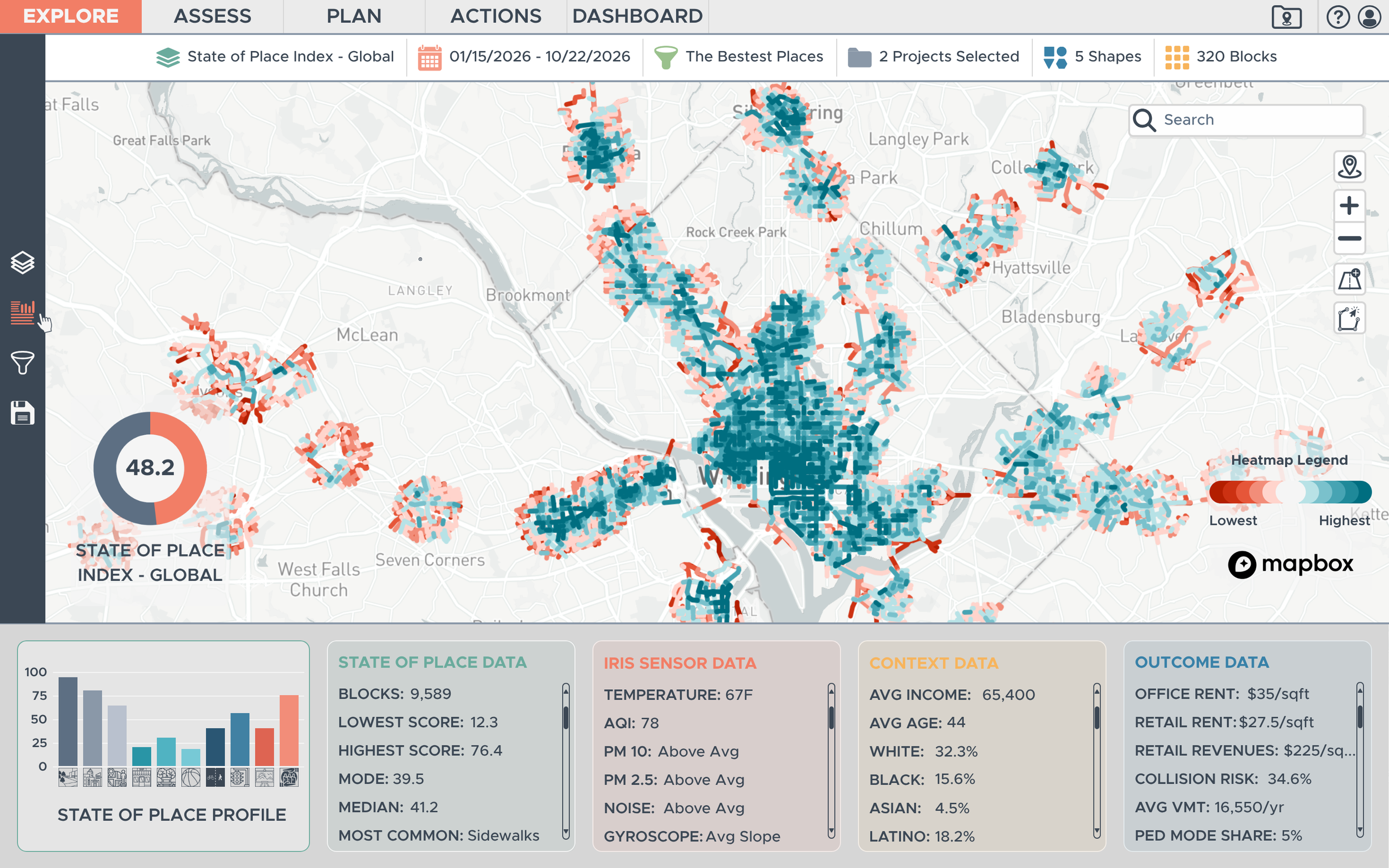
You cannot do everything, everywhere, all at once.
Limited Resources
Budgets, capital, staff capacity, and time are limited. Citymakers cannot address every need, so they must prioritize. But how do they know which choices will create the greatest value?
Difficult Trade-Offs
Public agencies: Which places and projects should you prioritize?
Developers: How do you maximize project value while navigating feasibility, financing, approvals, and community support?
Owners and investors: Which assets should receive capital, and where can it create the greatest upside?
Hard to Get to Yes
Stakeholders often have different, sometimes competing priorities. Without a clear, defensible case for why one approach should move forward, even strong plans, projects, and investments can stall.
Where should you focus? What should you change? And why should those changes happen?
See what’s working, what isn’t, and where.
Sidewalks, trees, curb cuts, crossings, storefronts, parking, public spaces - we measure nearly 150 built environment features, block by block, across your entire city, region, or portfolio. Get a full inventory of what makes a place “tick” without having to walk every street yourself.
You know when a place feels right - and when it doesn’t. We put a number to that feeling: nearly 150 built environment features combine into the validated State of Place Index, a benchmark of built environment quality. The State of Place Profile breaks that score into 10 aspects of urban design, showing you what’s working and what’s not.
Combine built environment, sensor, social, economic, health, and environmental data to uncover areas of divestment and opportunity - then identify the places you want to optimize, from a single block or corridor to a custom area or locations across a city or portfolio that meet your criteria.
What’s missing isn’t always what matters most.
Tell us what outcomes you want to achieve: reduce collisions, lower disease risk, increase rents, or raise property values. Then tell us for whom, where, by how much, and under what conditions.
Our models quantify which aspects of the built environment matter most to those outcomes. We combine that evidence with your existing assets and needs, account for what is actually feasible, and then recommend what to change, where, by how much, and in what combination.
Finally, we compile those recommendations into project-wide scenarios, each with a different combination of changes. We rank them by how well they achieve your goals and the level of effort required to do so. You can modify those scenarios or design your own from scratch.
Get to yes.
Quantify each scenario’s economic, social, health, and/or environmental value - from increased retail revenues and property values to fewer collisions, lower disease risk, reduced heat exposure, and less crime - and estimate its return on investment.
Compare scenarios based on the value they generate and the effort they require. Weigh near-term actions against longer-term investments, and see where additional effort produces meaningful gains - or diminishing returns.
Bring decision-makers, partners, and communities into the process to refine existing scenarios, create their own, and see the results for themselves.
Give investors, boards, city councils, and communities a defensible reason to say yes - and secure the required approvals, funding, and buy-in.
State of Place at work
Built for the people who shape places.
See how State of Place helps public agencies, developers, owners, and investors prioritize what matters, maximize value, and build the case to move projects and investments forward.
Public agencies
Put limited public resources where they will have the greatest impact.
Prioritize plans, projects, and capital investments that deliver the most value for limited resources, and show decision-makers and communities why the recommended approaches deserve funding and support.
Developers
Maximize project value while making a stronger case to get it built.
Test design and development alternatives, quantify projected upside and ROI, and build a defensible case for financing, approvals, and community support.
Owners and investors
Know what’s driving asset performance - and where capital can create the most upside.
See which built environment conditions shape asset performance, identify where targeted changes could create value, and make stronger acquisition, repositioning, capital allocation, and hold-or-sell decisions.
Case Studies


The State of Place Extended Family
From local governments and national railways to developers and design firms, more than 50 citymakers worldwide have used State of Place to turn data and evidence into better plans, projects, and investments.









What our customers have to say!
-

"State of Place is the only tool on the market today that allows us to measure the change in walkability of a neighborhood as a result of a proposed development project, and allows us to rate and compare different projects across different locations"
Maggie Super Church
CLF Ventures
-

"State of Place helped us with [our] long-term strategic vision. It helped [us] to think critically about where we should invest in... We have been using it and we'll continue to integrate that in our planning, our economic development, and even in our infrastructure department"
Lloyd Purdy
City of Tigard
-

"Everyone has great ideas, but the hardest part is GETTING IT DONE. Having this sort of data, a very well built model, is a powerful way to get it done. [State of Place] enables me to bring a gun to the gunfight, finally leveling the playing field."
Raphael Clemente
West Palm Beach Downtown Development Authority
Ready to deliver better places?
See how State of Place can help you assesses built environment conditions, prioritize what and where to build to optimize value, & quantify that value to get funding, approvals, & buy-in.
The City of Bowie asked State of Place to identify and prioritize built environment improvements that could boost economic development across three core commercial areas - and provide the evidence needed to support those investments. We used computer vision to extract data on 127 urban design features across the Washington, DC region, then combined those data with economic and demographic measures to identify which aspects of urban design had the greatest impact on real estate value. We then generated block-level recommendations, evaluated more than 920,000 potential combinations, and identified three top-performing scenarios for each focus area across varying levels of effort. Finally, we quantified the real estate upside and ROI of each scenario, giving Bowie an evidence-based roadmap to optimize its investments and build the case for funding, approvals, and stakeholder buy-in.
Read the case study to see how State of Place collects and transforms built environment data into actionable investment strategies.